

“With Communion in the hand,” says Bishop Juan Rodolfo Laise of San Luis “a miracle would be required during each distribution of Communion to avoid some Particles from falling to the ground or remaining in the hand of the faithful…. Let us speak clearly: whoever receives Communion in the mouth not only follows exactly the tradition handed down but also the wish expressed by the last Popes and thus avoids placing himself in the occasion of committing a sin by negligently dropping a fragment of the Body of Christ.”.
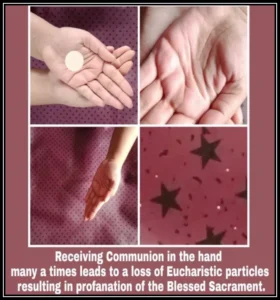
Since this is the case, why would we multiply immensely the number of persons who are handling the Sacred Host, some of whom are clumsy, or cannot see well, or don’t care, or don’t know, etc., who cause particles of the Sacred Host to remain on their hands, drop onto their clothing and to the floor? For those who believe with lively faith, this question ought to be enough to put an end to Communion in the hand: “What about the Fragments?” Therefore, very great reverence, respect and care is to be taken of these fragments. This we can do only when we receive on the tongue.
When a person receives Communion in the hand, their hand is covered with hundreds of tiny particles. It is almost impossible to consume all of them. ‘ When a person receives Communion on the tongue, there is not a problem about particles because the particles fall on the tongue and are consumed. Another problem with Communion in the hand is touching the Bread of Eternal Life with unclean hands. However unintended, this is irreverence. We should be down on our knees, heads bowed reverently with the utmost humility to Our Lord and receiving Him only with our tongues, not daring to touch His sacred Body with our dirty hands, which is often the case. This does not mean that our tongue is more holy than our hands but that our hands are more prone to dirt than our month. It goes without saying that we should keep our tongue and hands free from being the instruments of sin.
The loss of reverence is another reason to stop receiving in the hand. To the catholic who keeps on receiving the Bread of life, in a casual manner, just as he receives any ordinary food, will eventually lose the reverence and later belief in the real presence. Today roughly 70% of Catholics in America do not believe in the real presence of Our Lord in the Holy Communion. The state of Catholics in the rest of the world is not any better. Such are the fruits of Communion in the hand. (Matthew 7:17-23)
The fourth reason is the rise of black masses. Satanists are very happy about Communion in the hand, because now it is much easier for them to get a hold of consecrated hosts to desecrate in their black masses. Before Communion in the hand, satanists had to pay fallen or unscrupulous Catholics to pretend to take Communion in the mouth and smuggle it out. Now, all a satanist has to do is to go to a Mass and receive Communion in the hand. Mike Warnke, a former satanist high priest who converted to Christianity, warned the U.S. Bishops that allowing Communion in the hand was a mistake, as it would allow satanists easier access in procuring the sacred host, which is desecrated at satanic services.
These are the major reasons why it is not scrupulous or rigid to stop receiving in the hand. Communion on the tongue is a more careful, more reverent and the perfect way of receiving Our Divine Saviour. Modern history bears sobering witness: wherever the practice of receiving Communion in the hand has spread, belief in the Real Presence has weakened, and Eucharistic sacrileges have multiplied. This reality should cause every faithful Catholic to tremble at the thought of receiving Our Lord in the hand again. In the pages that follow, we will see how Heaven, Purgatory, and even Hell bear testimony to a singular truth: the only truly safe, fitting, and reverent way to receive the King of Kings is on the tongue—with humility, love, and profound adoration. If we truly seek to honor Our Eucharistic Lord with the most noble and reverent act possible, then this is the way—the sublime way.
If we truly love Our Lord, then we should not receive Communion in the hand ever again and should educate and encourage others as well, to receive only on the tongue and in the state of grace. Also, wherever kneeling is possible, receive on the tongue while kneeling. Besides being modest, being in the state of grace, being fulfilled the law of Eucharistic fast, kneeling and receiving on the tongue will please Our beloved Saviour the most. For, if we believe that the Holy Eucharist is the Body of Christ, then our actions must reflect that belief. We should approach it with the same reverence, awe, and respect we would show to God Himself.