7. The Plot of the enemies of GOD and of His Church
Ever wonder why the Catholic Church no longer condemn freemasonry, communism or modernism, like in the pre-Vatican II times? Every wonder why almost all the liturgical and doctrinal changes since the mid-twenties, are similar to the belief and practices of the protestant churches?
We have all heard the expression, “There is more than meets the eye”. This is very much applicable when it comes to the liturgical changes after Vatican II Council.
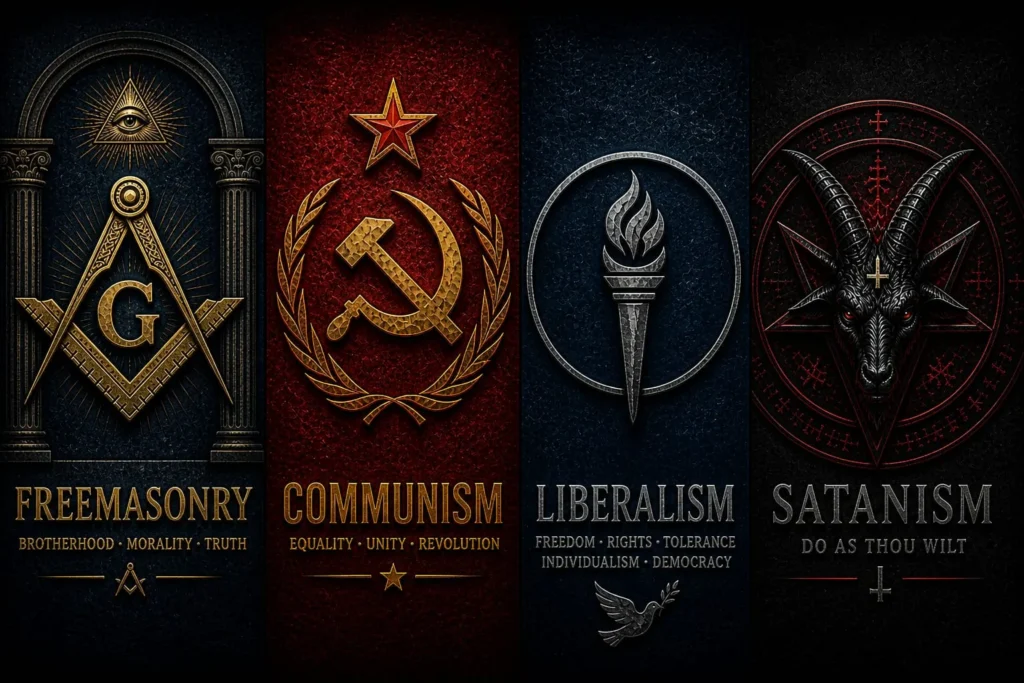
There is sufficient evidence to point out the role of freemasons, inside and outside the church, especially those in hierarchical position inside the Church, in almost all the changes that reshaped the Church since 1960s. There are also some interesting documents which reveal their plot to destroy the Church from within. One such documents has this shocking goal, “Make women and laymen distribute the Communion. Tell them this is the time for the laymen. Begin with the deposition of the Communion in the hands, as the Protestants, instead of on the tongue. Explain that Christ did it in the same way. Collect some hosts for the “black masses” in our temples”. – # 29, THE MASONIC PLAN FOR THE DESTRUCTION OF THE CATHOLIC CHURCH.
I want to again remind to the reader, that the purpose of this work is not to provide a detailed history. The purpose is to open the door and to shed light on.
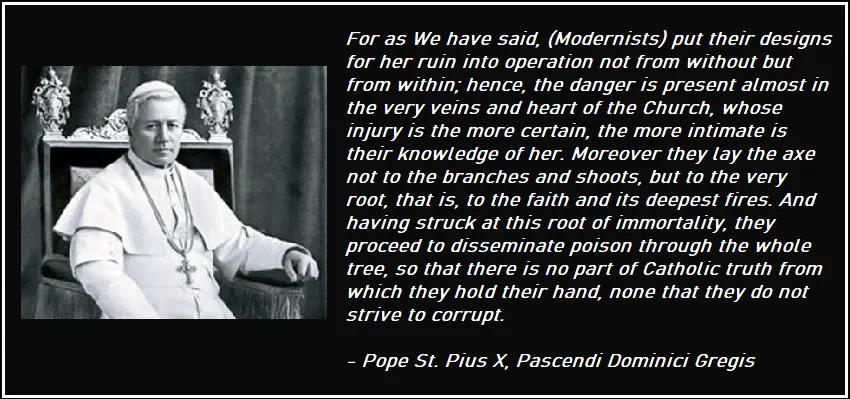
Moving forward, the freemasons were not alone. They found support from the liberal prelates within the Church, who had similar agenda to shape the church according to the modernist theology. Pope Saint Pius X had already condemned modernism as “the synthesis of all heresies” in his 1907 encyclical Pascendi Dominici Gregis. By the 1960s, those freemasons and modernists were at the highest places in the Church. There was another party at play here – the communists. The communists, who viewed the Catholic Church as one of their greatest adversaries, had begun infiltrating the Church as early as the 1930s. Historically, the Church has repeatedly condemned communism for its atheistic and materialist ideologies. For a deeper exploration of this complex and unsettling history, I highly recommend Dr. Taylor Marshall’s captivating and thoroughly researched book, Infiltration: The Plot to Destroy the Church from Within.
In the years following the Second Vatican Council, Holy Communion began to be distributed to people in their hands. This was mainly done in the countries of France, Belgium, Holland, and Germany and it was done without the permission of the Church. Until then, Holy Communion could only be received directly on the tongue. The Vatican and the Holy Father intervened a number of times, telling the cardinals and bishops and priests to stop it, but they continued to disobey. Archbishop Ranjith notes that the practice of receiving Communion in the hand was not mandated by Vatican II, nor was it introduced in response to calls from the laity. Instead, he argues, the established practice of piety – receiving the Eucharist kneeling, on the tongue – was changed “improperly and hurriedly,” and became widespread even before it was formally approved by the Vatican.
In 1965, Pope Paul VI sent a survey to the bishops, asking: “Do you think a positive response should be given to the request to all the rite of receiving communion in the hand?” The results were as follows: (a) 1,253 were opposed; (b) 567 were in favor. Nevertheless, those liberal bishops and priests who promoted communion in the hand, did so by convincing the faithful that it was a noble ancient practice but swept under the rug all the reasons the Church had forbade and later abolished the practice.
The Modernist Deception:
One of the greatest tragedies that hit the Church in modern times, is the heresy of modernism. Since the late 19th Century, the modernist tried to reinterpret Catholic doctrines on the basis of modern ideas. The supernatural aspect of every doctrine was replaced with natural explanation. They did not spare even the miracles of Our Lord, which they over simplified to diminish all supernatural traits to suite their new theology. These modernists once done with corrupting the sacred doctrine, laid their eyes on the sacred liturgy. They were fully aware that by undermining the supernatural elements of the liturgy, they would effectively introduce a new theology at the core of the Church. These internal adversaries also subscribe to the principle of Lex Orandi, Lex Credendi, which asserts that our worship reflects our beliefs. As a result, the Traditional Latin Mass was supplanted by the New Order Mass.
When it comes to the reception of the Holy Communion, another strategy was used by the modernists, namely, antiquarianism (also known as archaeologism). This approach lies at the heart of many arguments favoring liturgical reform. Antiquarianism, in this context, is a selective and often distorted appropriation of certain early Church practices, used by modernists to justify innovations aligned with their new theological perspectives. Much like Protestantism, it bears a strong aversion to the medieval tradition, scholastic theology, and the teachings solidified at the Council of Trent. Pope Pius XII in his encyclical letter Mediator Dei, warned about ‘exaggerated and senseless antiquarianism.’
The protestant reformers returned to Communion in the hand because it suited their new belief that the Holy Eucharist is not the actual Body and Blood of Jesus Christ. What was the intentions of the so-called catholic reformers of the late 20th Century, whom we now know to be notoriously liberals, in returning to Communion in the hand, and side lining the beautiful practice of kneeling and receiving on the tongue? Why were the changes brought after Vatican II Council, more in harmony with protestant theology then with Catholic theology? Why every liturgical change after Vatican II, are stripped of the supernatural and sublime aspects, in the disguise of returning to the simplicity of the early church?
A careful study of post–Vatican II history shows that the introduction and eventual normalization of Communion in the hand did not emerge from theological consensus or organic liturgical development. Instead, it was marked by doctrinal ambiguity, manipulated voting, selective half-truths, and a concerning degree of ignorance among both laity and clergy. False appeals to obedience, coupled with the silence or frailty of many Church leaders, allowed this rupture in Eucharistic reverence to take root across the Catholic world. The purpose of this work, is not to go into these details. You can read the books “Communion In The Hand: Documents And History” by Most Rev. Juan Rodolfo Laise and “On Communion in the Hand and Similar Frauds” by Michael Davies, for more on this subject.
To conclude, just as satan demonstrated the ability to misuse Scripture for his deceptive aims, so too have his agents learned to manipulate early Church traditions to legitimize their theological innovations. Such confusion and corruptions are permitted by Divine Providence as a form of spiritual chastisement—a consequence of our collective sins. In this age of trial, the faithful are refined, called to watch, to weep, and to walk the narrow path of truth once more.
Martyr & Saint Cardinal John Fisher rightly said, “Times of flowering or collapse within the history of the Church were always associated with the handling of the Holy Eucharist.” This quote is very interesting, given that with the introduction of Communion in the hand and extraordinary ministers, in modern times, the state of the Church and the world has been worst. Maria Simma calls Hand Communion, “the work of the devil”; she also repeats often what the Poor Souls tell her, and an often-expressed worry of theirs is that “the Church of today is in the worst shape than it has been since its very beginning.”