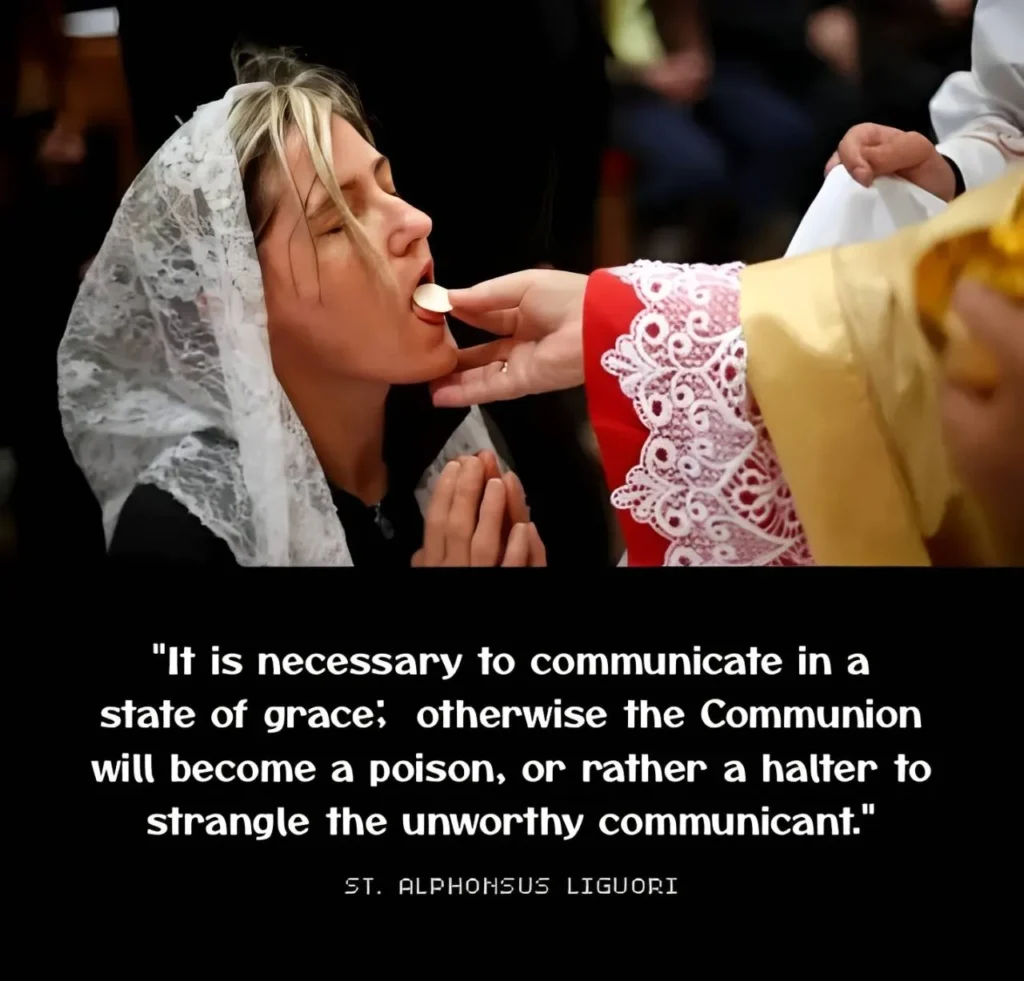
At the present day, says St. Anselm, are many taken with various diseases after the Eucharist because they have received unworthily the Lord’s body. And many die prematurely because they have communicated unworthily and without preparation. So says Sts. Anselm and Chrysostom. They were even vexed by the devil because of this sin. Cf. St. Chrysostom (Hom. 5 in 1 Tim.). St. Cyprian (de Lapsis) gives examples. He says that some who had eaten things offered to idols, and then received the Eucharist, were struck dumb; another pulled out her tongue; a girl, after eating of idol-meats, vomited the elements. Francis Suarez piously warns us from this how careful a watch should be kept by every communicant over his tongue, because the tongue is the first member to receive Christ, and is the instrument by which He begins to be assimilated. (THE GREAT BIBLICAL COMMENTARY OF CORNELIUS À LAPIDE)
The Council of Trent states that “…no one, conscious to himself of mortal sin, how contrite soever he may seem to himself, ought to approach to the sacred Eucharist without previous sacramental confession.“
“Anyone who desires to receive Christ in Eucharistic Communion must be in the state of grace. Anyone aware of having sinned mortally must not receive communion without having received absolution in the sacrament of penance.” Catechism of the Catholic Church #1415
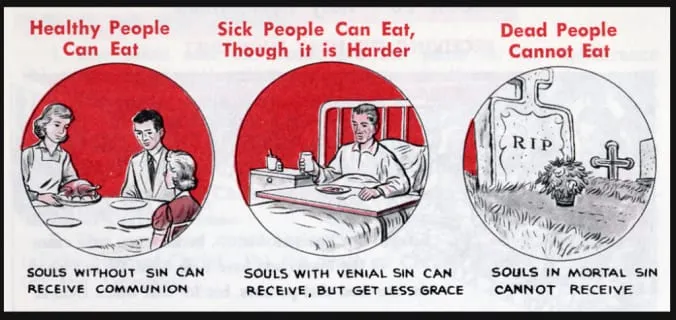
One does not have to confess, if the sin is venial. However, if a Catholic has committed mortal sin but is truly sorry for them; yet he should not receive Holy Communion without a sincere Confession. A Catholic is obliged to attend Holy Mass every Sunday and on the days of Obligation, but he is not obliged to receive Holy Communion during every Holy Mass. I have earnestly warned many Catholics around me, including some of my own relatives, to go to confession before receiving Holy Communion, especially when they appear to be in a state of mortal sin. Tragically, the response I often receive is one of genuine confusion: they sincerely claim they are unaware of having committed any mortal sin. This reveals a grave lack of understanding about the nature of sin. For many, only extreme acts like murder, rape, or theft are considered serious sins, as if those were the only offenses capable of severing one’s relationship with God. This widespread misconception, even among those who are otherwise devout and striving for holiness, is a sobering reflection of how poorly sin and moral theology have been taught in recent times. It is a crisis that urgently needs to be addressed within the Church.
Woe to those who, persisting in grave sin, withdraw from the life-giving Sacraments, for they reject the very means ordained by Christ for their salvation (cf. John 6:53-54). Yet more perilous is the state of those who dare to approach the Holy Eucharist unworthily (1 Cor 11:27 – 29). Most grievous still is the scandal of those who, contrary to the constant teaching of the Church (cf. Catechism of the Catholic Church, 1385), encourage the faithful to receive Our Lord while in a state of mortal sin, or who administer the Eucharist illicitly—offending not only divine law, but endangering souls entrusted to their care.
Our Lord lamented to Prophet Hosea, “My people are destroyed for lack of knowledge…and thou hast forgotten the law of thy God…” This lament is towards both the priests and the children of Israel. Are not these words of Our Lord more applicable to the Church today, both priests and laity? The priests no longer remind the faithful to approach Our Lord in the Holy Communion, reverently and in the state of grace. The faithful no longer examines his conscience before receiving their Eucharistic Lord. The loss of the sense of sin is one of the greatest tragedies of our times. Pope Pius XII famously said, “The greatest sin today is that men have lost the sense of sin”. Sins, especially mortal sins, are so normal and common today, that Catholics no longer know or believe such and such a thing said or done or omitted can be a serious sin. For example, many Catholics do not know that skipping Holy Mass on Sundays and Holy days of obligation, without a good reason, is a mortal sin and must be confessed. Partaking in non-Catholic worship, sex outside marriage, alcohol or drug abuse, lying or gossiping that resulted in serious negative impact on someone, looking at or thinking lustfully about someone are some of the mortal sins that need to be confessed. If someone wants to learn about various mortal sins, all he/she has to do is understand the Ten Commandments, the Laws and Precepts of the Church, and the types of Vices and their counterpart Virtues. There are some good Catholic books available on Examination of Conscience and the Confession guides for adults and children, that will be very helpful in this regard.